
The Thinness Obsession: The Convo We Aren't Having
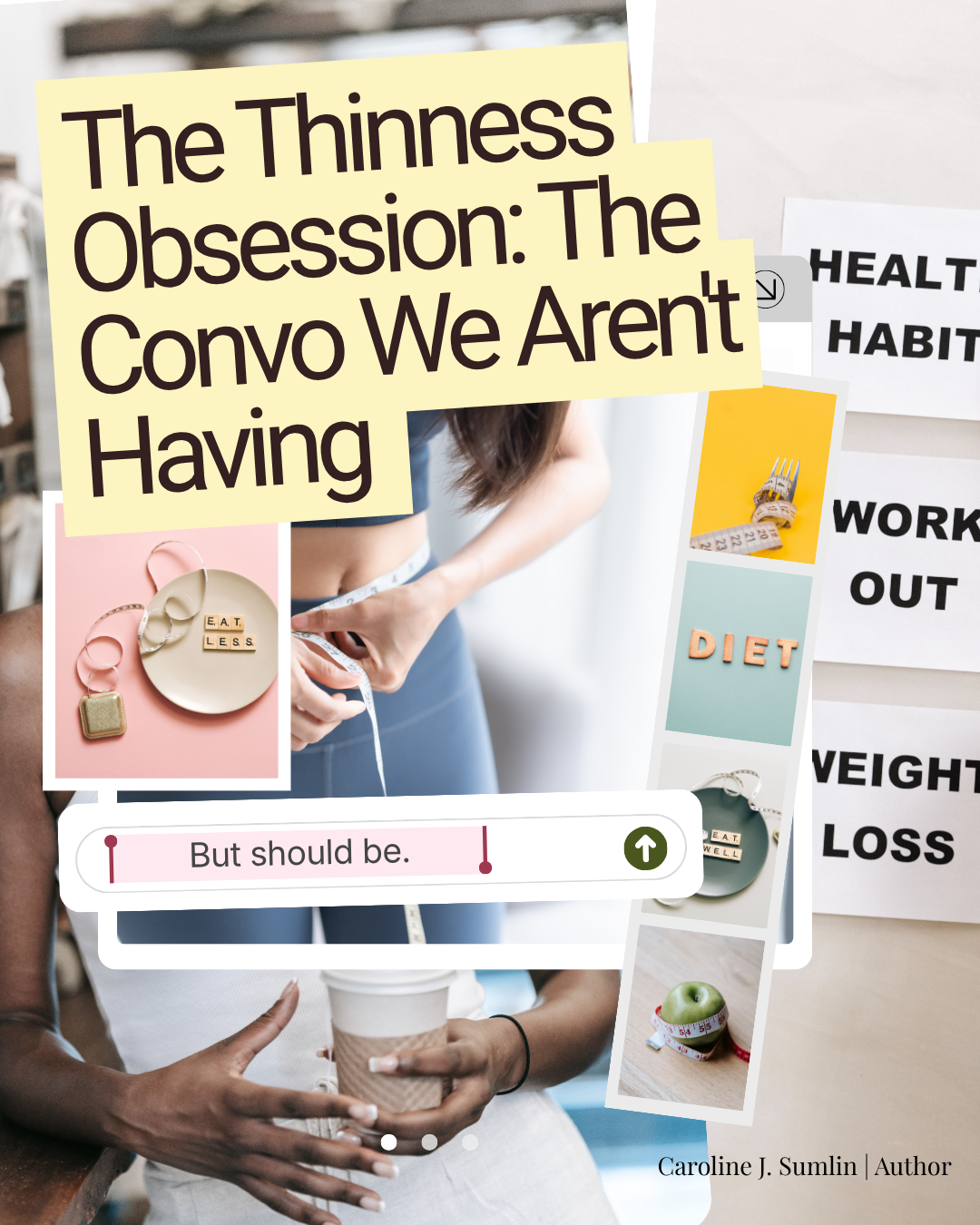
Every week there seems to be a new conversation circulating the internet. And while this week is no different, the recent conversation around society’s resurgent obsession with thinness has been ongoing for several months. From prominent athletes promoting GLP-1s, to Hollywood celebrities becoming alarmingly thin overnight, to an entire subculture of TikTok known as “skinnyTok,” it is clear we have done a complete 180 from the body positive movement of the 2010s.
After several decades of damning beauty and body standards in the ‘90s and ‘00s, many of us breathed major sighs of relief in the 2010s when we felt free to put that harm behind us, embrace the natural jiggles and wiggles of the human body, and eat a pizza without “guilt” for crying out loud. We started drinking dairy again, eating real bread, and saying an unapologetic “yes” to our sugar cravings. Finally, different body types were represented in media, clothing brands, and pop culture—helping us realize what a normal body actually looked like.
While things weren’t perfect—inclusive body representation still heavily favored those who were lighter, brighter, and held curves in a more “favorable way”—it’s safe to say that it felt like the generational trauma of fat-phobia and the thinness obsession was starting to end. We still had work to do, but we believed we had finally reached the light at the end of the tunnel. I don’t think any of us could have predicted where we would be just a decade later.
Now, it’s a decade later, and the obsession with thinness has returned with a vengeance—and it’s more terrifying and dangerous than ever.
Thinness has not only “returned” as the latest standard to strive for, but malnourished bodies are being doted as “normal,” “toned,” and “the healthiest (x) person has ever been,” which has the potential to have even more a maleficent effect on the the latest generation of young people than the heroine chic era of the ‘90s had on millennials and Gen X. Especially with social media exponentially multiplying how often images and videos of these trends are jammed into our brainwaves without our consent.
Thankfully, we are talking about it.
Many are quickly catching on to what’s happening and raising concern about how quickly disordered behavior around food, fitness, and bodies is becoming normalized again. We do not want a repeat of the horrors we grew up with that we are still healing from. (To this day, I can’t look in a mirror without doing a scan of my body to see if it looks any smaller than it did yesterday. 😩)
(Note: I’m not supporting speaking about individual celebrities bodies and picking them apart. I am in support of discussing the overall toxicity we are seeing in beauty culture in hopes of putting an end to it before it gets even more out of hand.)
But, there’s a major part of this discussion that’s missing, which is inadvertently causing further harm. Everyone is talking about how “thinness is back,” but very few are stating why thinness was ever the standard to begin with.
Thinness Was Never a Trend
While it’s true that societal and cultural trends tend to come and go, oftentimes in a cycle only to resurge every few decades, we must be careful not to treat thinness as as trend that simply resurfaces like capris or bell-bottom jeans. (Also, can we not?! I will not be wearing capris again thank you very much.)
Thin-obsession is not simply a trend that just appeared out of nowhere in the ‘80s and ‘90s. Like every cultural standard, there is a root cause—an ideology that strengthens overtime to cultivate the normalized narrative we know today. And even when we were experiencing a bit of a break from that obsession during the body positive era of the 2010s, thinness and Eurocentric body standards never fully “went out of style.”
Even then, curvier bodies still had to meet a standard to be considered acceptable. Curves had to exist in your hips and not your belly. Your waist still needed an hourglass shape to be seen as “sexy.” If you existed in a bigger body, your hair, skin, and nails better be the embodiment of perfection. Rarely did we see someone with darker skin and a bigger body represented in the media. And the biggest bodies never received the same acceptance as the midsize bodies that were considered closer to the “cultural standard.” What we now know as a healthy-sized body was considered plus-sized in the ‘90s ad ‘00s, so representation of those bodies in the 2010swas considered “inclusive,” but a size 10 was typically where the line was drawn.
But, back to the point.
Eurocentric beauty standards—which point toward a thin, slender, restrained body as a more “worthy and desirable” body—are not simply cyclical trends that reappear as quickly as the wind blows. They are deep-seated mechanisms of hierarchal reinforcement, designed specifically as an extension of anti-Blackness and a means to reinforce the supremacy of whiteness.
And when theres’s a resurgence of those standards?
That’s white supremacy working overtime to re-exert itself as dominant, which almost always coincides with a rise in more authoritarian, conservative, and political turmoil.
If we aren’t being honest about this in our conversations, the cycle will never actually break. Just like we were fooled in the 2010s, we will be fooled again, and again, and again.
…the cycle will never actually break. Just like we were fooled in the 2010s, we will be fooled again, and again, and again.
Thinness Became a Moral Virtue
Standards, norms, beliefs, and other cultural ideals don’t just pop up out of nowhere, but the majority of us treat them like they do. When something has become so normalized, especially when it’s harmful, we rarely question where it came from. It just feels like a way of life, or the way things have “always been.”
Fat-phobia and thin-obsession, in my opinion, is the most normalized expression of white supremacy culture today. We have generations of conditioning telling us that fat = bad, and anything slightly larger than a toothpick is fat. This is so normalized that most people don’t think twice about commenting on other people’s bodies, judging other’s bodies, creating entire lifestyles and personalities around fat-avoidance, treating bodies like never-ending projects, and so much more. No matter your race, class, gender, job-title, or any other identifier, the worst thing you can be—according to society—is fat.
Here’s the kicker: this anti-fat ideology was constructed solely out of anti-Blackness.
When Europeans began “othering” Africans and creating the concept of race to justify racism and slavery, weight became one of the stigmatized markers of inferiority. Due to the natural curvature of an African body, Europeans used their “weight” or “size” to claim they were lazy, gluttonous, and unintelligent.2 These false depictions were not only used to justify colonization and enslavement, but as a precedent for physical standards that Europeans should adhere to. Written media strongly encouraged white Europeans to maintain their thinness and docile nature to separate themselves from Black people.
The goal was to ensure there were as many justifiers for the supremacy of whiteness they were building.
So, white people—especially women—were instructed to eat as little as possible to demonstrate discipline, intellect, and moral superiority. Religious superiority also played a major role, as the Protestant movement used food restriction and thinness as a way to pressure congregants to showcase evidence of piety and refinement. And whiteness.
The more those narratives spread, the more fatness was linked directly to Blackness. The message? “If you’re fat, you’re just as lazy, gluttonous, and dumb as those N-words.”
(This is not a direct quote, but an illustration of the mood of the time.)
To avoid ever being placed in such a low position of society, food became something to control. The thinner you were, the more disciplined, virtuous, and worthy you appeared.
The Same Lie, Reinvented
The moral superiority around thinness hasn’t gone anywhere. It’s simply reinvented itself with each generation—a new trend, mechanism, or reason for reaching the “ideal body” becoming the latest tool wielded by the capitalist-driven white supremacy machine. Even though the trends and standards themselves have slightly shifted with each decade, the foundation of it all has always been the same: restrict, control, and contort your body to prove that you are “more morally superior” than the person next to you.
And remember, moral superiority is just a proxy for whiteness.
We would be remiss to act as though the thinness obsession began in the ‘90s and ‘00s. What we witnessed during those eras was simply those decades’ version of what had been solidified into our culture’s DNA centuries prior: prove you are a good, respectable, disciplined, and civilized member of society—and separate yourself as much as possible from Blackness by fearing fat and controlling your body.
And yes—this still held true during the 2010s. It was just a sightly more acceptable, slightly less thin-obsessed version of this narrative. Diet culture was still reinventing itself as it does with every decade. There was just more open pushback against this narrative because of the visible harm it had caused so many for so long. That doesn’t mean the narrative disappeared. It was just met with a bit more resistance and alternative ways to still strive for that standard without, perhaps, knocking on death’s door to do so.
When Power Feels Threatened
The early to mid 2010s was also much more politically balanced time than the early 2000s. We had elected our first Black president in 2008, and again in 2012. The economy was rebounding from the Great Recession of 2008. Many socially progressive gains were made that brought hope and opportunity to marginalized communities. Gay marriage was legalized. Social media was still a place to share dimly lit photos of a tree you saw on your morning walk. Michael Jackson and Whitney Houston were still alive!
People were happy.
The mood surrounding society was generally optimistic for the future. And when the political climate is more stable, people are more likely to let loose a bit and stop focusing on every way they can control themselves to feel a sense of security. When a society feels secure, its constituents let go of the need to create their own safety. When society feels unstable, one of the first responses to that instability is to find a way to control yourself in a way that feels protective, and that often begins with your body.
Society also knows this, which is why the narrative around body image often shifts when things begin to feel politically uncertain. Economic downfall and political unrest is almost always met with renewed messaging around weight loss, body image, and control. It often begins with a new gimmick or fashionable way for people to access, or buy into, something to help them control their bodies.
A few historic examples of this:
In the 1920s, during a period of post-war instability, intentional weight loss became a newly celebrated symbol of virtue. Fatness was once again re-defined as a failure of self-discipline and self-restraint and thinness became evidence of those virtues. Prior to this era, the standard came from the Victorian era, which honored a bit more of a curvier frame (though still slender—remember that underlying foundation). When instability occurs, whatever standard was before it breaks down, often leading the pendulum to swing in the opposite direction. We can see this presently, as we are in a post-Obama era backlash, post-pandemic, and post-human-and-civil-rights-actually-existing society.
During the Great Depression, when many people were literally starving, thinness became the inevitable consequence, causing the more elite classes to stray away from looking too thin, which would indicate suffering. However, and this happens all the time, Hollywood and media packaged up that thin, boyish stature and labeled it as the standard to strive for. We see this often during economic instability—the aesthetic of the lower classes becomes the marker of “chic” with the notable ones. You can currently see this with the bare nails trend, no mascara trend, less makeup trend, and yes, the resurgence of thin. The standard becomes a competition between who looks like they are choosing restriction (discipline, moral superiority) and who is just “surviving it.” Discipline is only virtuous when it's optional.
When we get to the 1990s, the “heroine chic” era rose in popularity during the rejection of 1980s materialism and economic stagnation. After the 1980s entertained an era of unrealized aspirations, the economy responded with a recession in the early ‘90s. Just like during other recession eras, the response was to turn literal struggle into a status symbol—a sign you were rejecting the excess and indulgence of the era before it. This era also idealized drug dependency, making it look sexy to suffer with addiction. The ‘90s brought with it a sharp increase in disordered eating behavior amongst women everywhere who desired their bodies to be as thin as possible.5This is the era we are seeing revived today, and it just so happens we are experiencing economic and political uncertainty, signs of recession, and authoritarianism. Except, this time, the drug of choice is GLP-1s—advertised everywhere as your solution for getting the desired body, and status symbol, you’ve always desired.
Discipline is only virtuous when it’s optional.
Thin obsession not only surges during economic uncertainly, but as a response to women and marginalized people gaining a bit too much power for white supremacy’s liking.
The ‘60s and 70’s are an example of this, as is today. (Yes, I think today’s response is both economic and a rejection of power and freedom.) The ‘60s and ‘70s are known for movements of resistance, fights for Civil Rights, counterculture, gender equality, and sexual liberation. These “socially progressive” wins dared to challenge the authority and standard of white supremacy.
The thin ideal remained constant during these two decades, but for different reasons. In the ‘60s, much of the thin standard came from rejecting the more voluptuous, curvy aesthetic of a traditional housewife from decades prior. A more androgynous style and body type represented more freedom. However, once the ‘70s hit, the thin standard shifted from freedom to control as backlash to the progress made in the ‘60s, and post-Vietnam war political upheaval, caused an end to an era of prosperity. Second-wave feminism was rising, and the result was to continue appealing to women to shrink their bodies, and therefore themselves.
Again, I believe we are seeing this today. Not only are we dealing with political turmoil and economic uncertainty, but we are also witnessing a rise in authoritarianism, an historic attack on women’s and civil rights, a rise in Christian nationalism and trad wife culture, silencing of marginalized voices, and so much more. So, it’s no surprise that, once again, the primary tool white supremacy uses to assert its power, is making an aggressive, calculated comeback.
I dive more deeply into the history of fat-phobia and Eurocentric beauty standards in my book, We’ll All Be Free: How a Culture of White Supremacy Devalues Us and How We can Reclaim Our True Worth. Chapter five to be exact.
If We Don't Name It, We Can't Stop It
History repeats itself because we have never disrupted the foundation it built. And we continue avoiding it. It’s wonderful that we are recognizing the toxicity of skinny’s return, and the detriment to our physical and mental wellbeing it causes. But, if the conversation simply stops there, we are doing nothing to prevent this very mechanism from making another inevitable comeback in a decade or so.
White supremacy has one goal and one goal alone: remain in power. And it will do so by any means necessary.
Keeping people, namely women, believing that they are only as worthy as the size of their waist circumference and how well you can see their clavicle protruding removes their power, voice, and energy to resist the system. It continues to feed the ideal that there is a social hierarchy—one pretending to be determined by “moral superiority” but really structured by race–and you can control your positioning within that hierarchy if you just shrink yourself. It’s a myth, but we still don’t realize it. It’s white supremacy’s oldest lie.
Breaking the Cycle
So, what do we do?
For one, we need to have the honest conversation. Move the chatter away from the celebrity gossip and toward the truth: thin obsession didn’t just happen to wander its way back into the trend cycle like low-rise jeans. It has always been the current beneath the surface of American culture.
Most days, it's subtle enough that we hardly notice it. We simply learn to swim with it. But whenever white supremacy feels threatened, that current accelerates. What once felt like a gentle pull becomes something much stronger—dragging us back toward the same old hierarchy under the guise of health, discipline, beauty, or self-improvement.
…thin obsession didn’t just happen to wander its way back into the trend cycle like low-rise jeans. It has always been the current beneath the surface of American culture.
It will find ways to disguise itself—taking the face of new fads, trends, and aspirations. And if you aren’t aware of its game, you’ll be entranced—falling for whatever new, shiny gimmick it waves in front of your face that will finally make you feel worthy.
Telling the truth about the root of this current, and its forever existence, will help more of us be prepared every single time it feels threatened and resurges. And hopefully, with each time it tries, we get a little better at catching it before it gets out of control.
And then maybe, one day, we can say we’ve defeated it altogether.
The work starts here.
With the truth.
If this essay resonated with you, consider becoming a paid subscriber over on Substack. Your support allows me to keep researching, writing, and telling the stories that often go untold. If you're new here, We'll All Be Free expands many of the ideas in this essay—including the history behind fat-phobia and Eurocentric beauty standards. And if a subscription isn't for you, buying me a coffee is always appreciated.
Thank you for being here.
Sources:
https://csalateral.org/reviews/fearing-black-body-racial-origins-fat-phobia-strings-sturgis/
https://digpodcast.org/2024/07/28/history-of-thin/
https://sociology.sites.gettysburg.edu/capstones/johnni03/beauty-ideals-through-a-historical-lens/
https://grokipedia.com/page/Heroin_chic
https://sociology.sites.gettysburg.edu/capstones/johnni03/beauty-ideals-through-a-historical-lens/